

Registering your business comes with many benefits and advantages such as limited liability, legal protection, tax benefits, access to funding, credibility, etc. In South Africa, you can register your company as a non-profit company or a profit company with the Companies and Intellectual Property Commission (CIPC). Under the Companies Act, the profit companies can be incorporated as sole proprietorships, partnerships, private companies, or public companies.

A sole proprietorship is a business starting as a sole hustle without partners. Partnerships involve two or more founding partners, providing additional support if necessary. A private company is a separate legal entity, allowing entrepreneurs to start independently without risk of asset seizure. A public company, on the other hand, trades its shares on a stock exchange, allowing anyone to become an equity owner.
The government of South Africa has been promoting entrepreneurship especially among the youths through access to funding and capital therefore contributing to job creation and economic growth.
The Registration Process
Two types of companies may be formed and incorporated under this Act, namely profit companies and non-profit companies. A profit company is— (a) a state-owned company; or (b) a private company if— (i) it is not a state-owned company; and (ii) its Memorandum of Incorporation— (aa) prohibits it from offering any of its securities to the public; and (bb) restricts the transferability of its securities; (c) a personal liability company if— (i) it meets the criteria for a private company; and (ii) its Memorandum of Incorporation states that it is a personal liability company; or (d) a public company, in any other case.
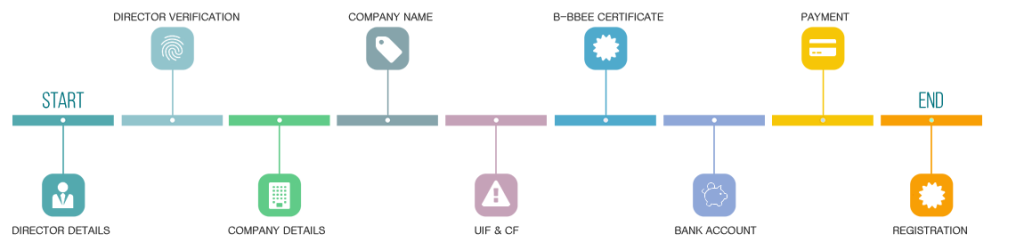
The company registration process entails simple steps as illustrated by this diagram below.




Name Reservation
The Companies Act, of 2008 allows for-profit companies, such as private companies, to register with or without a company name, while not-for-profit companies must have a name. A company’s registration number automatically becomes the company name with South Africa as the suffix. A private company can transact with a trading name or apply to add a reserved name later. If the initial name reservation is not approved, new names must be applied, costing R50. It is advised to confirm the use of a proposed name before submitting.
Available Platforms for name reservations:
- New E-services – www.cipc.co.za / Online Transacting / New E-services
- BizPortal – www.bizportal.gov.za
- CIPC Mobile App
- Self Service Terminal
- Banks (as part of the company registration process)
- Associated name reservations or names requiring supporting documentation [email protected]
- e-Services – www.cipc.co.za / Online Transacting / e-Services
Documents for Company Registration
For you to register your company in South Africa, you need to submit the following documents: Notice of Incorporation, Memorandum of Incorporation, and a few supporting documents.
Notice of Incorporation contains:
- Company name
- Whether the company name serves as the registration number
- A list of four names to be checked by the Commission.
- The reserved name and reservation number
- Date of Incorporation
- Financial year-end
- Type of company
- Incorporation date
- Financial year-end
- Registered address (where your head office is based)
- Number of directors
Memorandum of Incorporation
The document should include the:
- Founders’ details
- The number of directors or alternate directors in the business
- The amount of share capital.
Other Supporting Documents
To incorporate a new business, provide certified ID, initial directors, incorporators, power of attorney, and valid name reservation document. Then these forms and documents also need to be submitted CoR 14.1, CoR 15.1A for a normal private company, or CoR 15.1B for a customized private company. All these can be downloaded from the Companies and Intellectual Property Commission (CIPC) website.
Registering for SARS
To register a business in South Africa, you need to first complete the registration process with the Companies and Intellectual Property Commission (CIPC). Once this is done, you can proceed to register with the South African Revenue Service (SARS) to obtain an Income Tax reference number. The CIPC registration will trigger the automatic generation of the Income Tax reference number by SARS. Afterward, taxpayers must register on eFiling for electronic transactions.